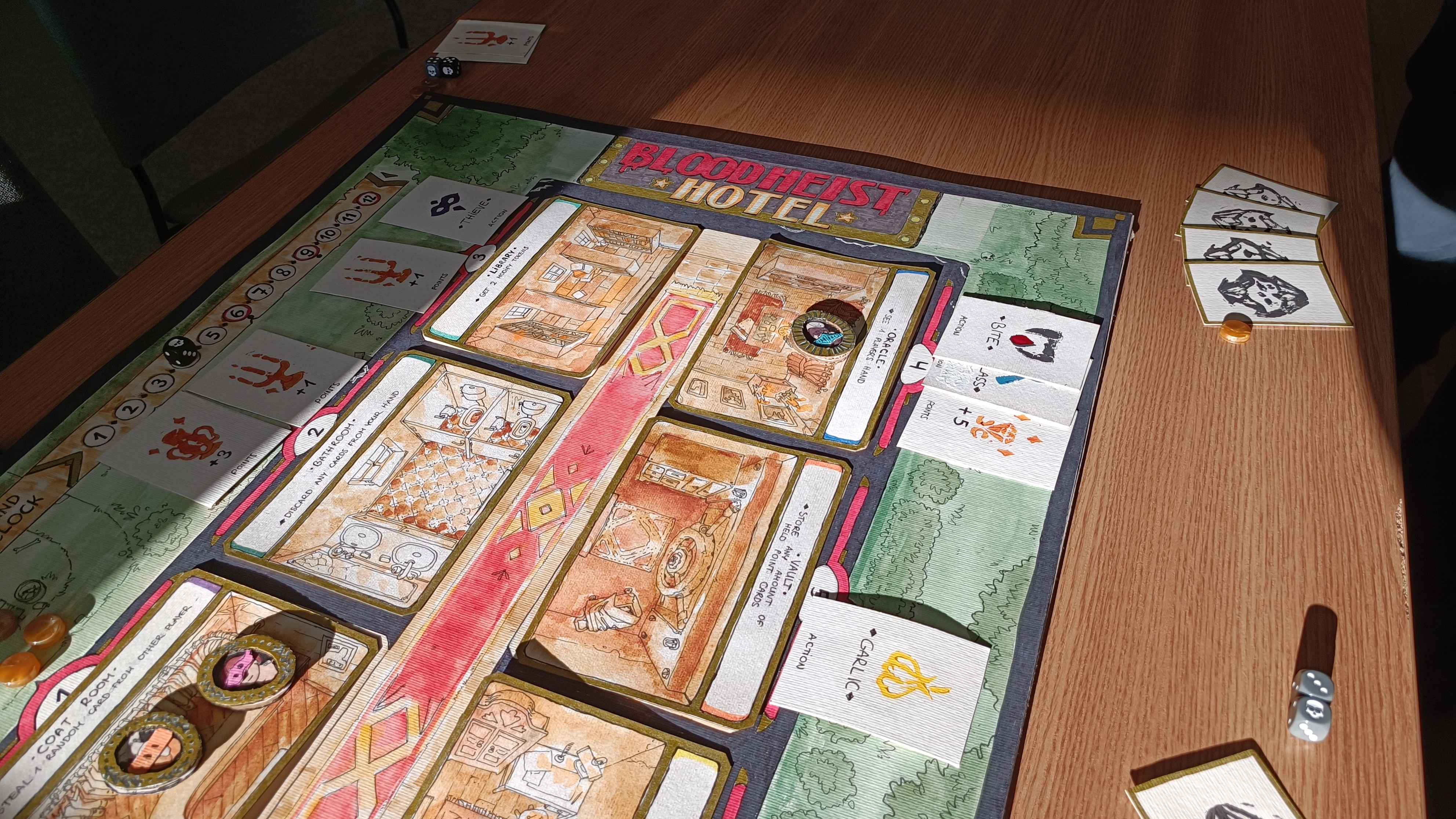
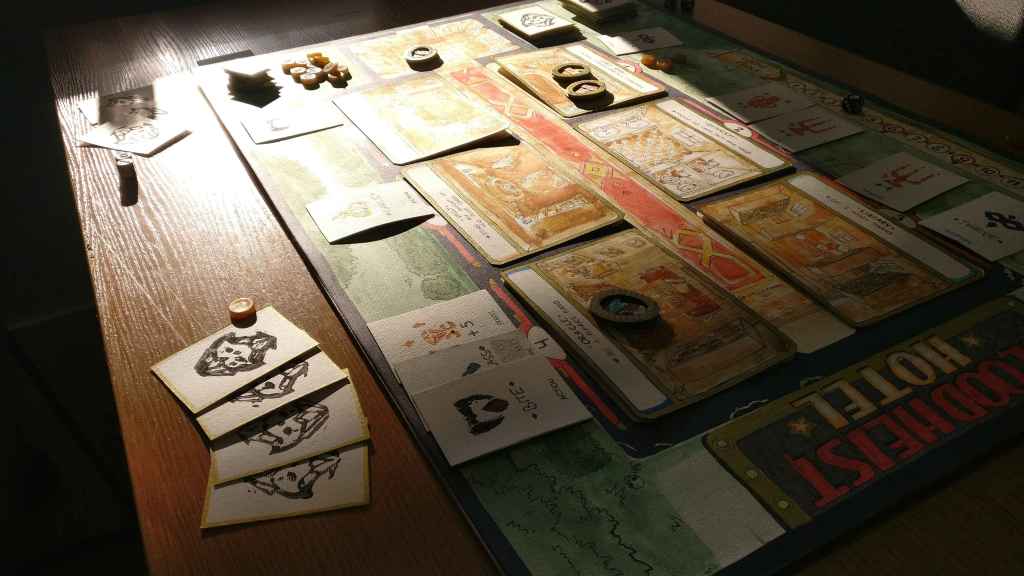
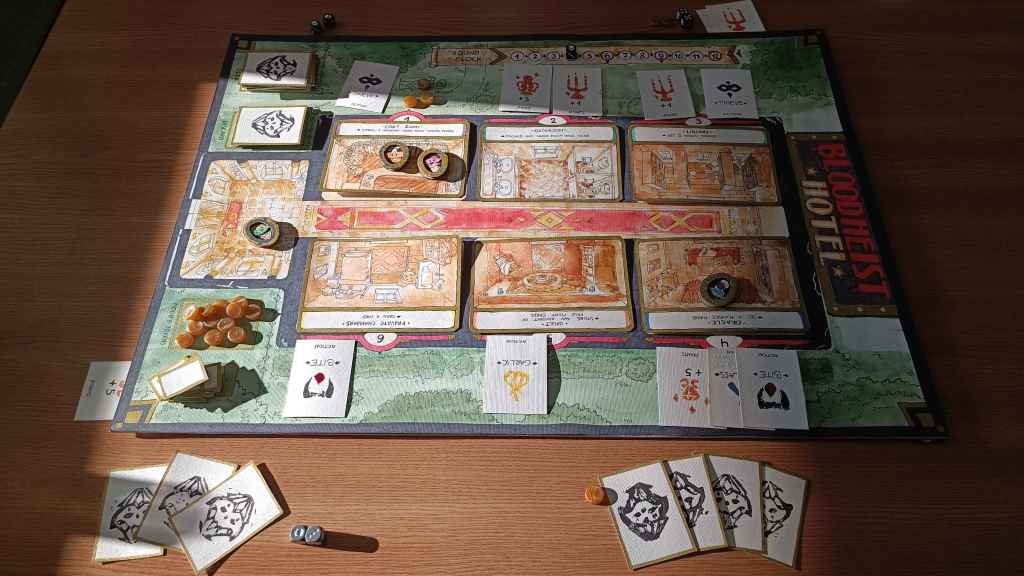
From January 30th to February 1st I participated in the Global Game Jam with Daugvydas Surkys (2D, Game Design – ArtStation), Vaiva Vaivadaitė (2D – ArtStation) and Mantas Butkus (2D – ArtStation). Based on the theme “Mask” we created an asymmetric social deduction table-top game about humans exploring, stealing from each and looting the hotel, while the vampiric hotel owner is hunting them to make them its minions. While we did not win any awards, there were players who enjoyed the game and wanted to play more, which I consider a personal victory!
For Bloodheist Hotel I contributed by:
- Game design and documentation
- Managing playtests
- Adjusting the games rules and balance based on the playtests
- Writing the trailer script, that was then used for audio recording
- Managing the game submission to the GGJ website
Game rules
Cards
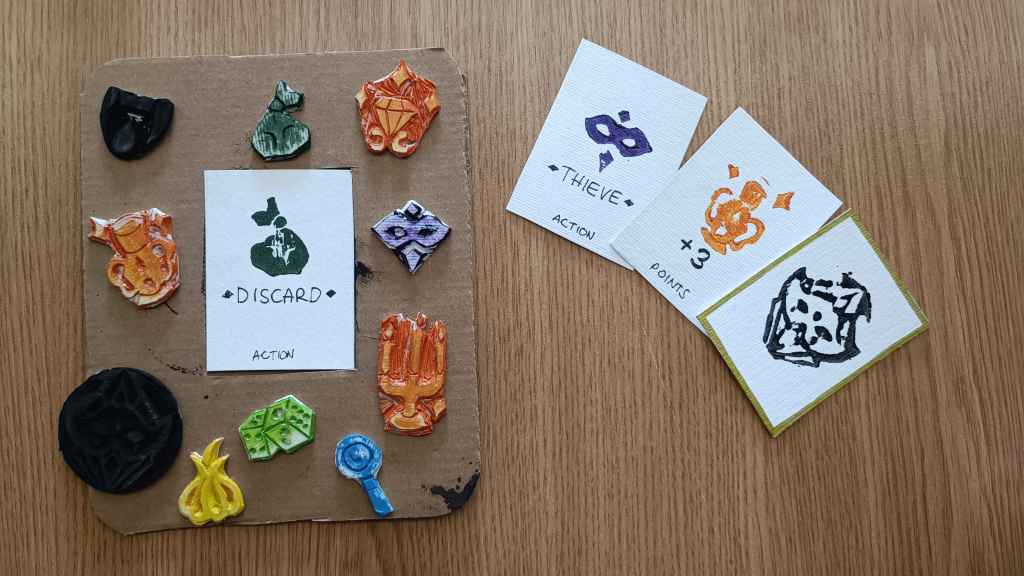
| Name | Description | Activation time | Count in deck |
|---|---|---|---|
| +1 | Score cards | 10 | |
| +3 | Score cards | 6 | |
| +5 | Score cards | 3 | |
| Modify token | +/- 1 to turn priority or room number | When declaring the priority and room number | |
| Reroll | Reroll one of dices | When rolling for priority and room number | 4 |
| Bite | Convert the receiver into a vampire | Given only by the vampire and only when in the room trading cards | 6 |
| Garlic | Prevents the giver from being turned into a vampire | When being traded in the room | 6 |
| Spy glass | Look at one random card from any other players hand | Anytime in your turn | 3 |
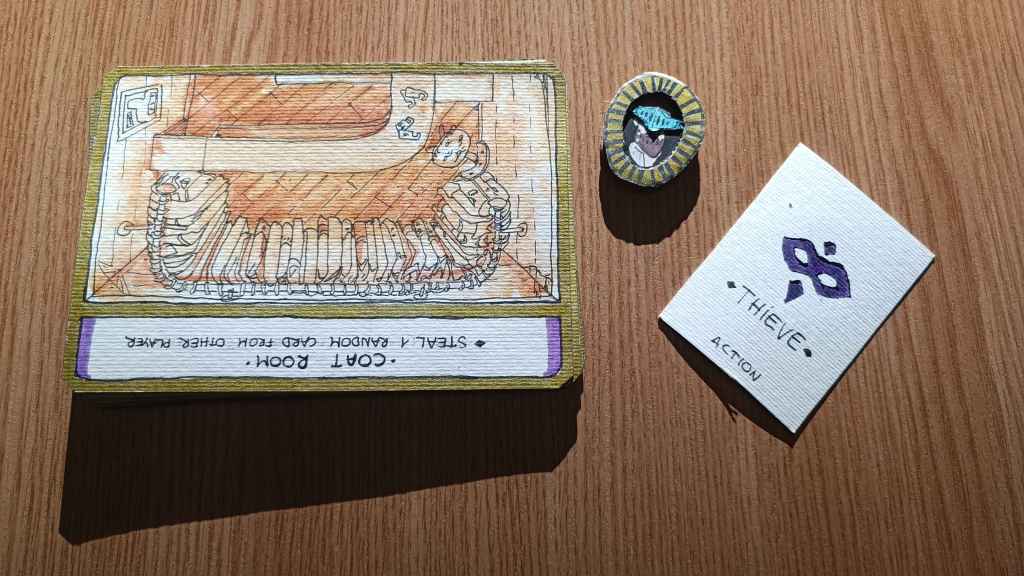
| Thief | Pick any one random card from any other players hand. Can also steal modify tokens | Anytime in your turn | 3 |
| Trash bag | Discard this any up to 2 any other cards in your hand | Anytime in your turn | 6 |
| Vampire role | Represents player role | 8 in role deck | |
| Human role | Represents player role | 8 in role deck |
Trailer
Additional notes
- Initially there were cards like “Lock the room”, “Heal Vampirism” and “Force move”, but they added in too much complexity in a way that reduced clarity;
- During initial ideation we wanted to capture the feeling of suddenly changing teams, which is why when a player becomes a vampire, their win condition changes. This also allowed for infected players to continue playing;
- Since player identities are unknown, the 6th and the 9th clock tick checks were introduced to finish the game early when all the players become vampires. This also created space for scenarios where it is revealed that there are 3 vampires and one human, causing the mood of the game to drastically shift;
- A design problem that was left unresolved was helping players remember that they were turned into vampires. We considered many different physical methods, but eventually gave up on the idea, as any physical action after being converted would reveal to the rest of the players what happened. Eventually, we decided to leave this problem, as it could create fun moments between friends when someone forgets the team they are playing as;
- Originally the player turn order had the player activate the room effect only after they played their action cards, which resulted in unequal synergies, such as a player with “Thief” card in the reveal hand room not being able to do the same as a player with “Spyglass” card in the steal a card room. If further developed, we would try to give player freedom to choose between action cards and room effects;
- We decided to allow the human players to infect other human players, despite the narrative dissonance, because it simplified the rules, and most importantly created space for an interesting high risk and high reward scenarios, where the player with the lowest score takes down the highest scoring player and attempts to survive as sole player, thus winning;
- One common issue that the game had was resolving the same priority numbers between the players. Initially we tried settling it with a coin flip, then with a dice roll. But it still was complicated. We then got the suggestion to try using room numbers as a way to resolve it. First we tried having the highest room number give the highest priority, but then switched to the lowest number giving the highest priority for consistency and simplification reasons;

 Martynas Antipenkovas